


Seamless Steel Pipes
The Mannesmann Process
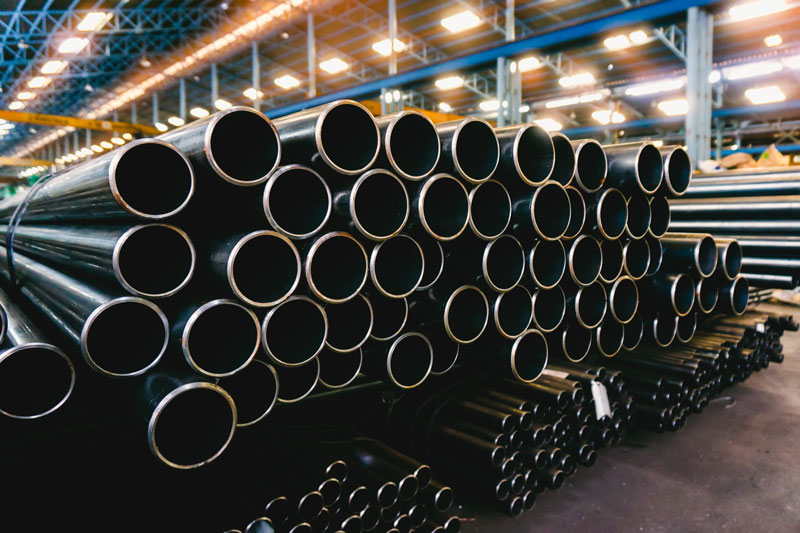
Seamless steel pipes are produced from solid cylindrical billets of carbon steel, stainless steel, or alloy steel. This manufacturing process involves heating and stretching the billet to form a hollow tube. No welding occurs during the process; hence, the pipes are seamless. The resulting pipes undergo rigorous hydrostatic testing to ensure their integrity and may be coated for added protection.
The concept of seamless pipes was pioneered by the Mannesmann brothers in 1886 in Germany. Due to their seamless construction, these pipes offer superior resistance to corrosion and can withstand higher pressures compared to welded pipes. Additionally, thicker-walled seamless pipes exhibit greater heat resistance.
Available in a wide range of sizes from 1/2 inch to 24 inches, seamless steel pipes find extensive applications in various industries, including:
Utilities: For high-pressure water lines
Gas transmission: For natural gas pipelines
Refining: In refineries and petrochemical plants

- Contact: +9831-3619
- info@kowsarsteel.com
Get free expert advice
Ask us your questions and problems
"*" indicates required fields
Seamless Steel Pipe Manufacturing Methods
Seamless steel pipes may be produced using two primary methods: the roll forging process and the mandrel mill process.
The Roll Forging Process
In the roll forging process, large, heated steel blocks, either square or circular in shape, are placed into furnaces to reach extremely high temperatures, often exceeding 1100 degrees Celsius. The heated blocks are then rapidly compressed into seamless tubes through a process of metal forging. This high-pressure process shapes the steel into a seamless tube, which is then cut to the desired length.
Advantages of the Roll Forging Process:
- Superior Mechanical Properties: Pipes produced through roll forging typically exhibit exceptional mechanical strength and desirable biocompatibility and physical properties.
- High-Quality Inner Surface: This method results in pipes with smooth inner surfaces, making them ideal for transporting sensitive fluids such as gases and oils.
- Production of Small-Diameter Pipes: Roll forging allows for the production of pipes with significantly smaller diameters and wall thicknesses compared to other methods.
Disadvantages of the Roll Forging Process:
- Higher Cost: The roll forging process is generally more expensive compared to other manufacturing methods.
- Size Limitations: This method may have limitations when producing larger-diameter pipes.
The Mandrel Mill Process
In the mandrel mill process, steel blocks are quickly pulled through a mandrel, which contains a die, and elongated. The result is a seamless tube which is extremely smooth on its inner surface, and with great mechanical properties. with a highly accurate and smooth inner surface.
Extrusion is a primary method for producing seamless steel pipes. In this process, molten steel is forced through a die by centrifugal force to form a tubular shape.
Advantages of the Mandrel Mill Process:
- Large-Scale Production: This method is well-suited for producing larger-diameter pipes compared to the roll forging method.
- Higher Efficiency: When producing pipes with thicker walls, mandrel mills have greater efficiency compared to other production methods.
-
Faster Production: The mandrel mill process generally offers higher production rates, making it more efficient for manufacturing seamless pipes.
Disadvantages of the Mandrel Mill Process:
- Interior Surface Quality: Pipes produced using this method may have slightly rougher inner surfaces compared to those produced through other methods, which might be unsuitable for certain applications.
- Mechanical Properties: The mechanical properties of pipes produced through this method may be slightly inferior in some cases.